
Everybody on Your Floor Is Counting to Five. You Just Can't Hear Them.
Let me tell you about a conversation I had with an owner a few weeks back. He's got a fabrication shop. Good business, good people, parking lot full by 6:15. He's frustrated because he can't read his own crew. His 40-year guy seems checked out. His best lead hand is restless. The 28-year-old he just trained up is already "looking around." And the kid he hired in March wants a promotion he hasn't earned yet.
He looked at me and said, "Brad, they're all over the place. I can't keep up with what any of them want."
Here's what I told him. They're not all over the place. They're all counting. Every one of them is running the same clock in their head, three to five years out, and every one is counting to something different. George is counting down to the door. The Gen X lead is counting the days till he hits the ceiling. The millennial's counting on you to show him where this goes. The new kid's counting on you for enough structure that he doesn't drown.
You can't hear the clock. But it's running in every head in that building. And the owners who learn to listen for it stop losing their best people.
Why three to five years? Because that's how people actually plan.
Nobody plans their whole life. They plan the next chunk of it. Ask a person where they'll be in twenty years, and you get a blank stare. Ask where they'll be in three to five years, and you get a real answer; that’s the window a human being can actually see.
Here's what most owners miss. That same window means something completely different depending on who's doing the counting. Run all five the same way, and you'll misread every one of them. So let's walk the floor.
George is counting down. Are you capturing what he knows before zero?
Start with your Boomer. Call him George; every shop has one. He's been there 41 years. He knows which machine runs hot, which weld holds, and which customer calls every Friday at 4:30 just to hear a voice. And George is inside a three-to-five year window to retirement, whether he's said it out loud or not.
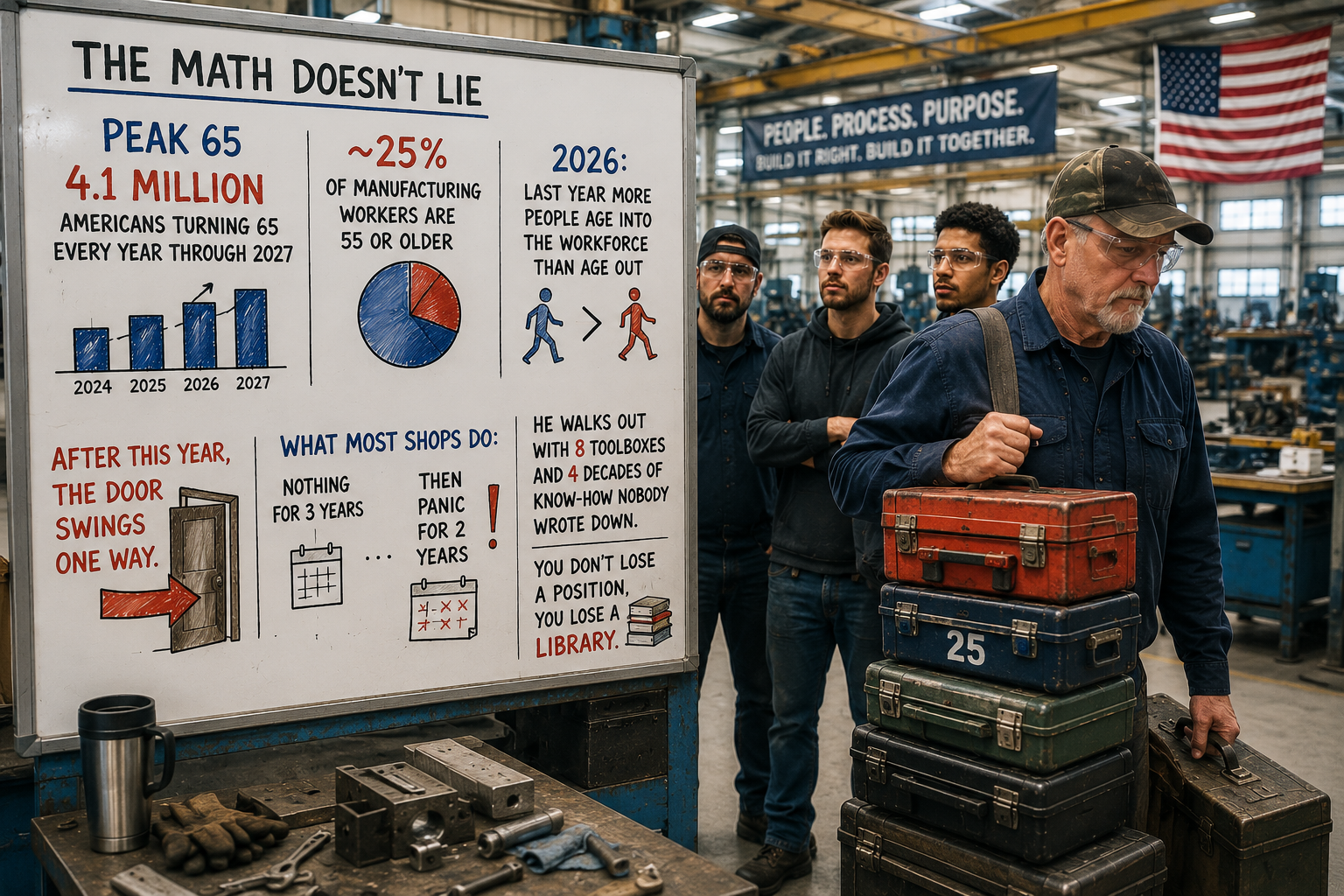
The math behind this isn't soft. In 2024, the country hit "Peak 65" roughly 4.1 million Americans turning 65 every year through 2027. About a quarter of manufacturing workers are already 55 or older. And 2026 is projected to be the last year more people age into the workforce than age out of it. After this year, the door swings one way.
So what do most shops do with George's window? Nothing for three years, then panic for two. The man walks out with eight toolboxes and four decades of know-how nobody wrote down, and you don't lose a position, you lose a library.
But George's clock is your biggest opportunity, not your biggest threat. A lot of these folks don't want to fully quit; they want to matter, to be useful. So design the role around what the window is good for: mentoring. Make teaching part of George's job, measured and on the clock. The person he trains builds the documentation and the videos. Now the knowledge stays when George doesn't. His countdown becomes your knowledge transfer plan.
Bill is counting to the ceiling. What happens when he hits it?
Next is your Gen X lead hand. Call him Bill. He runs your second shift, trains your new hires, and holds the whole thing together with duct tape and stubbornness. Gen X is about a third of the workforce and sits in more than half of all leadership seats. Nearly half have been with the same employer 20 years or more. These are not job-hoppers.
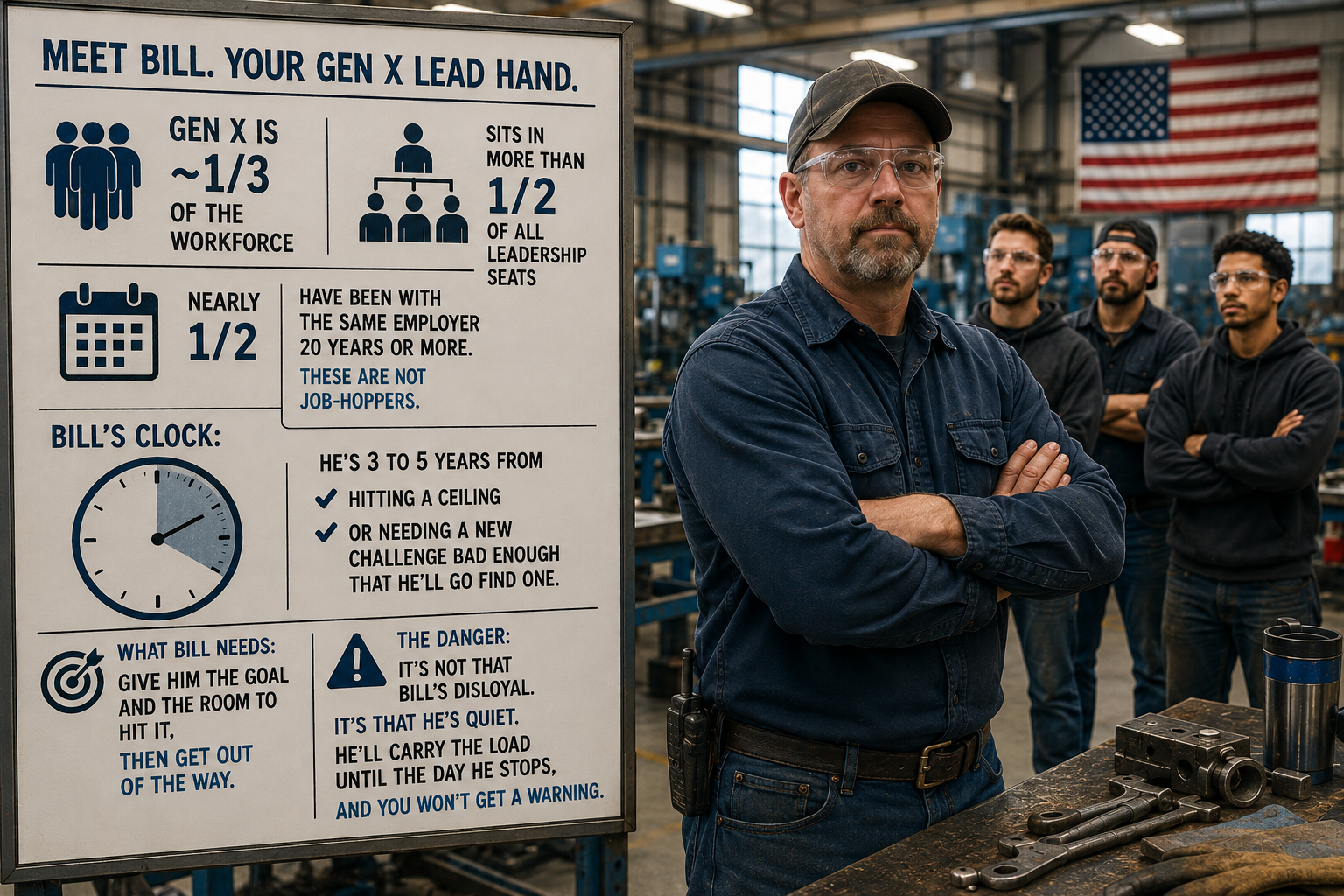
But here's Bill's clock. He's three to five years from hitting a ceiling, or from needing a new challenge bad enough that he'll go find one. Bill doesn't want a babysitter, and he won't beg. Give him the goal and the room to hit it, then get out of the way. The danger isn't that Bill's disloyal. It's that he's quiet. He'll carry the load until the day he stops, and you won't get a warning.
Design for Bill's window by giving him something to build. Gen X is your systems generation, the journeyman who knows where the bodies are buried. Put him in charge of the structure that outlasts any one person: the process, the standards, the way the shop runs. That's a ceiling worth climbing toward, and it keeps the guy holding your business together from walking out the back.
Aaron is counting on you to show him the path. Can you?
Now your millennial. Call him Aaron; he might even be you, the owner. Millennials are the largest single generation in the workforce, about 35% of it, and they've held the majority of management promotions since 2020. They're running your teams now.
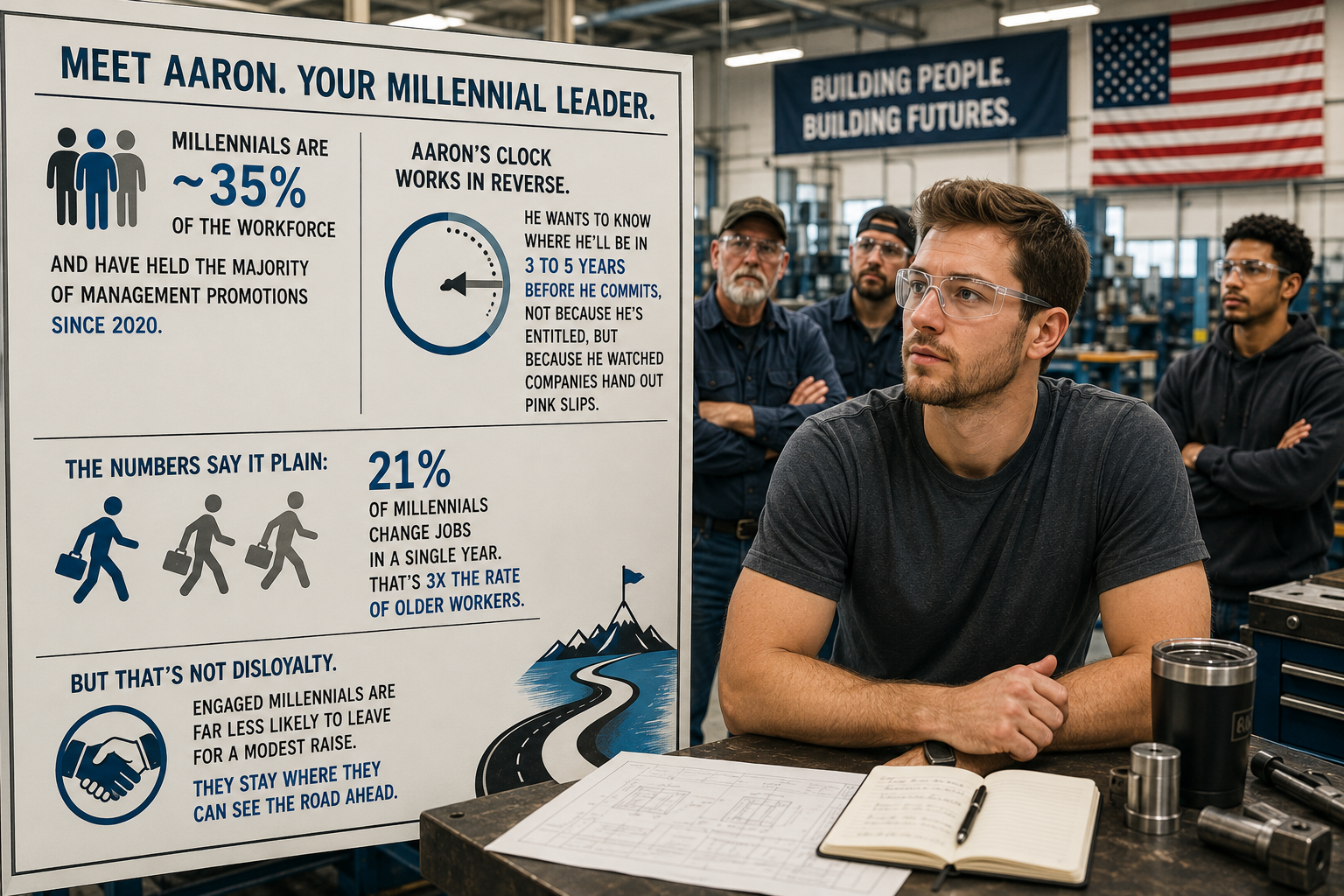
Aaron's clock works in reverse. He wants to know where he'll be in three to five years before he commits, not because he's entitled, but because he watched companies hand out pink slips and he's not betting his future on a handshake. The numbers say it plain: millennials change jobs more than any generation, 21% in a single year, three times the rate of older workers. But that's not disloyalty. Engaged ones are far less likely to leave for a modest raise. They stay where they can see the road ahead.
So show him the road. Aaron is your innovation generation; give him the improvements to own, the new line to stand up, the problem nobody's solved. A visible path with real ownership keeps Aaron. A vague "we'll see how it goes" sends him counting somewhere else.
Joshua needs three to five years of structure. Are you giving it, or guessing?
Then there's your Gen Z hire. Call him Joshua. There's a story going around that this kid won't work. The data says otherwise: 53% of Gen Z are seriously considering blue-collar or skilled trade work, and in 2024, workers 18 to 25 made up nearly a quarter of all new hires in the trades. They're showing up at your door.
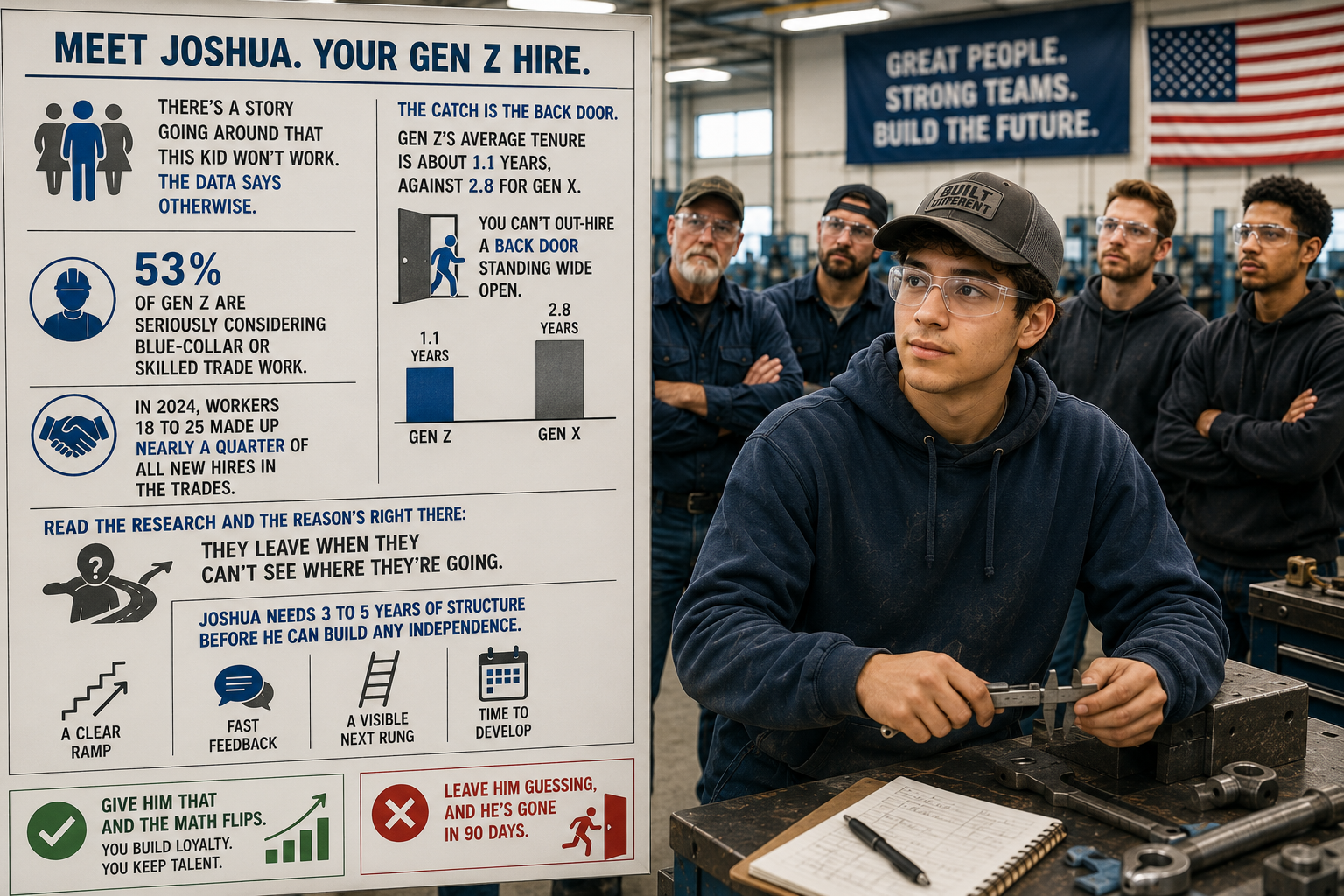
The catch is the back door. Gen Z's average tenure is about 1.1 years, against 2.8 for Gen X. You can't out-hire a back door standing wide open. But read the research and the reason's right there: they leave when they can't see where they're going. Joshua needs three to five years of structure before he can build any independence, a clear ramp, fast feedback, a visible next rung. Give him that and the math flips. Leave him guessing, and he's gone in 90 days.
Design for Joshua's window by building the ramp on purpose. Gen Z is your acceleration generation; they learned to learn on YouTube, hands-on and self-directed. Structured steps, frequent feedback, a clear "here's how you move up" that's not coddling. That's the difference between a kid who stays five years and one who costs you a recruiting fee twice a year.
And right behind Joshua is Parker, Gen Alpha, the oldest barely 16 now, clocking in around 2030. Same instincts as Gen Z, dialed up. Build the shop for Joshua's clock, and you're already ready for Parker's.
Here's the hard truth: you're not managing five generations. You're managing five clocks.
Most owners run all five on the same clock, or no clock at all. Same onboarding, same definition of "good" nobody ever wrote down. Then they're shocked when George feels disrespected, Bill burns out, Aaron's frustrated, and Joshua's gone by summer.
That's not a people problem. That's a design problem. And design problems are fixable.
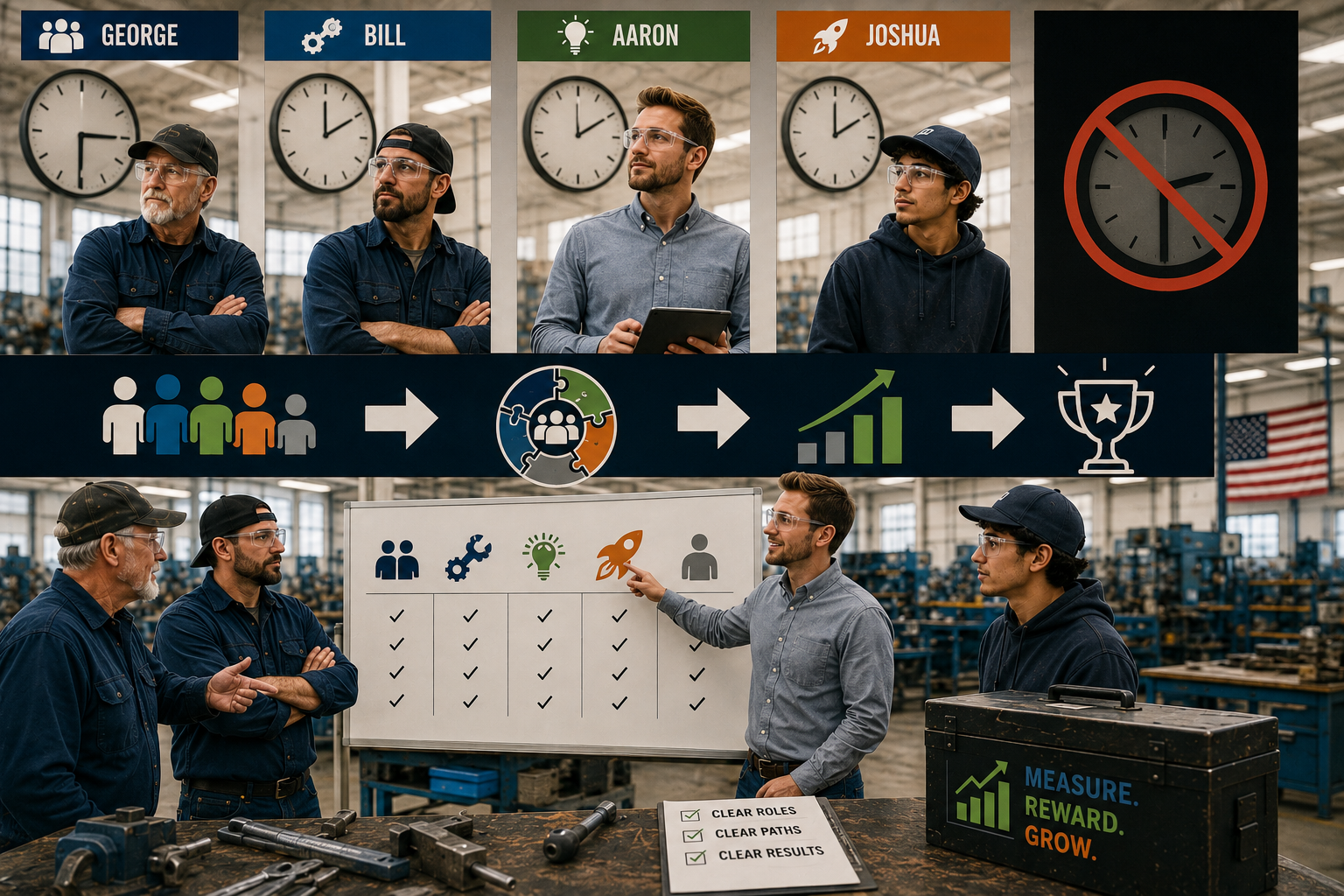
This is why I built the HERDA System: High-Engagement Results & Department Alignment. It defines what winning looks like in every role by results, not task lists, and designs those roles around how each generation's clock actually runs. George mentors. Bill builds. Aaron innovates. Joshua accelerates. You stop fighting the differences and start putting them to work.
But clarity alone won't keep them, because people don't just want to see the path, they want to see the money on it. That's why HERDA pairs with the Herda Wage System. Instead of paying for how long somebody's been in the building, it scores what actually makes a person valuable and ties it to a number they can move themselves. Now Joshua looks at the same scoreboard as George and sees exactly what the next raise takes. He's not counting on a handshake. He's counting on a formula he can read.
That's the flip. Five generations isn't a friction problem you survive. It's five clocks you can design for, and once you do, the thing every other shop calls a headache becomes the reason your people stay, and theirs don't.
Your challenge this week
Pick your five, one person from each generation in your building. Next to each name, write down where they are on their three-to-five year clock, and whether the job you've given them matches it.
George, capturing what he knows, or hoping? Bill, a ceiling worth climbing, or a wall? Aaron, can he see the road, or just the next job? Joshua, a ramp, or a guess?
Can't answer for even one of them? That's not a character flaw on the floor. That's a clock you stopped listening to. And the cost of a clock you ignore always shows up, usually two weeks' notice at a time.
What does winning look like for each of them? Write it down. That's where this starts.
BRING BRAD TO YOUR EVENT
If your association, leadership group, or industry conference is wrestling with a multigenerational workforce, this is the conversation your audience needs, and I bring real operational experience to the stage, not academic theory. My signature talk, "We Grew Up Different," gives your people a practical, no-fluff framework for turning generational friction into a competitive advantage they can use the very next morning. Email
bherda@focalpointcoaching.com or visit
bradherda.com to start the conversation.
Brad Herda
Vision Forward Business Solutions
Supporting blue-collar businesses to win their game every day