
Bill Holds Your Shop Together. When Did You Last Tell Him?
Why Gen X lead hands, supervisors, and plant managers in manufacturing and construction feel overlooked, what the 2025–2026 data says, and how to recognize, pay, and keep the generation bridging your retiring Boomers and your newest Gen Z hires.
It’s October. Playoff baseball.
Watch who the manager trusts in the eighth inning. It’s almost never the guy on the poster. It’s the utility infielder. Plays second on Tuesday, short on Wednesday, third when the starter tweaks a hamstring. Never makes the All-Star team. Never gets a bobblehead night. Pull him off the roster and watch the whole infield come apart.
Every shop has one. Call him Bill.
Bill is fifty-two. He runs your second shift. At 6:40 on a Tuesday night, George’s old press starts acting up, and Bill is the only one left who knows the trick George showed him back in 2009. He fixes it. Then he walks Joshua, your new Gen Z hire, through it twice so the kid can handle it next time. He covers a line for a guy who called in, finishes the setup sheet nobody else will touch, and steps outside on his break to call his mother about a ride to her appointment on Thursday.
You walk through at seven. “How are the numbers tonight?”
“We’re good.”
You nod and head home. So does Bill. Nobody said thank you. Nobody ever does.
What do you think happens next?
Not a blowup. Bill doesn’t do blowups. One Monday there’s a quiet two-week notice on your desk. Or worse, eighteen months from now there’s a new shop down the road with Bill’s name on the truck, two of your best hands on his payroll, and a couple of your customers on his schedule.
Here’s the hard truth. The most important person in your building might be the one you notice the least.
Why does Gen X feel overlooked at work?

Because they do the work that keeps things from going wrong, and nobody hands out recognition for problems that never happened. The data backs it up: Gen X is the least recognized generation in the workforce.
The Achievers Workforce Institute surveyed 3,600 employees for its 2025 State of Recognition study, released October 28, 2025. Only 17 percent of Gen X said they feel regularly and meaningfully recognized at work. That’s the lowest of any generation. Boomers came in at 21 percent. Gen Z at 28. Gen X also posted the lowest sense of belonging of any generation, at 22 percent.
Read that again. Fewer than one in five of the people running your shifts, your crews, and your departments feel like anybody notices.
The year before, Fortune reported Achievers data showing Gen X about 30 percent less likely than other generations to say they can share candid feedback and actually be heard, and 24 percent less likely to be enthusiastic about their job.
Now here’s what makes it dangerous. Gen X grew up as latchkey kids. They let themselves in after school, made their own dinner, and figured it out. They learned early that nobody was coming to check on them. So they don’t complain, and they don’t ask for a pat on the back. Quiet isn’t content. Quiet is a man who stopped expecting anything from you.
Why is Gen X so important in manufacturing and construction right now?

Gen X is the bridge between a retiring Boomer workforce and a fast-growing Gen Z workforce. They’re the ones turning decades of know-how into something a 22-year-old can actually use on Monday morning.
Look at what happened to construction in four years. The National Association of Home Builders’ analysis of Census data (October 2025) shows Boomers dropped from 20.6 percent of the construction labor force in 2019 to 14.2 percent in 2023. Gen Z more than doubled, from 6.4 percent to 14.1 percent. Gen X held the middle at 33.7 percent.
That’s your starting pitcher heading to the showers and a rookie coming out of the bullpen. Bill is the catcher calling every pitch.
Bill also believes in this work. Harris Poll data reported by Contractor Magazine found 45 percent of Gen X say the trades offer the best job opportunities today, compared to 38 percent of Gen Z. He’s not just your bridge. He’s your best recruiter, once you put him in front of the kids you’re trying to hire.
And he’s good at the job. In EY research reported by The CPA Journal, 70 percent of respondents named Gen X the generation best equipped to manage teams. Twenty-five percent picked Boomers. Five percent picked Millennials. That survey has a few years on it, but it matches what I see on every shop floor I walk. Gen X gets it done and doesn’t dress it up.
What happens when your Gen X supervisor quits?

You lose three things at once: the leader running the crew, the trainer moving Boomer knowledge to your younger workers, and the one person who knew where every problem was hiding. And the replacement market is close to empty.
The warning lights are already on. A 2023 Workforce Institute at UKG survey, cited by Fortune, found nearly half of middle managers want to quit, and Gen X fills most of those seats. Becker’s reported in December 2024 that 67 percent of Gen X say their jobs are changing faster than they can keep up.
Then add the squeeze at home. Kids still under the roof or in college. Parents who need rides to appointments. Bill carries the business all shift and carries the family after he clocks out.
Now picture the day he’s gone. In August I wrote about George, your Boomer veteran, and how his know-how walks out the door when nobody captures it. Here’s the part I didn’t say. Bill is usually the one capturing it. Lose Bill and George’s thirty years has no bridge to cross.
Go hire another one? Deloitte and The Manufacturing Institute project 3.8 million manufacturing workers needed by 2033, with about 1.9 million of those jobs at risk of going unfilled. You’re not finding another Bill on a job board.
And here’s the one that keeps owners up at night. A Sage report cited by The CPA Journal found Gen X was the leading generation of startup founders, at 55 percent. Old number, same instinct. When Bill can’t see a way up in your company, he already knows how to build his own.
How do you recognize Gen X employees without it feeling fake?
Be specific, be direct, and tie it to results. Gen X doesn’t want a pizza party or a plaque. They want proof you noticed exactly what they did and why it mattered.
Gen X can smell a canned “great job, team” from across the parking lot. It lands worse than saying nothing at all.
So say the real thing. “Bill, that press went down Tuesday and we still shipped. That was you. Thank you.” Fifteen seconds. Costs nothing. My guess is most owners haven’t said a sentence like that to their Bill in a year.
Then go further.
Ask him, then act on it. “What’s the one thing slowing your shift down?” Then fix it, and tell him you fixed it because he said so. The data says Gen X holds feedback back. Give him a reason to stop.
Give him ownership, not oversight. Set the target, set the guardrails, and get out of the way. Check his results, not his hours.
Show him the next step. Partner track, buy-in, a real seat in your succession plan. Too many owners planning an exit look right past the most likely buyer already in the building. When you don’t show Bill a future, he’ll go draw his own.
Want the deeper cut? Read The Carrot Principle by Adrian Gostick and Chester Elton. It’s a quick read, and it’ll change how you think about the fifteen seconds you never spend.
How do you pay for work that never shows up on the schedule?
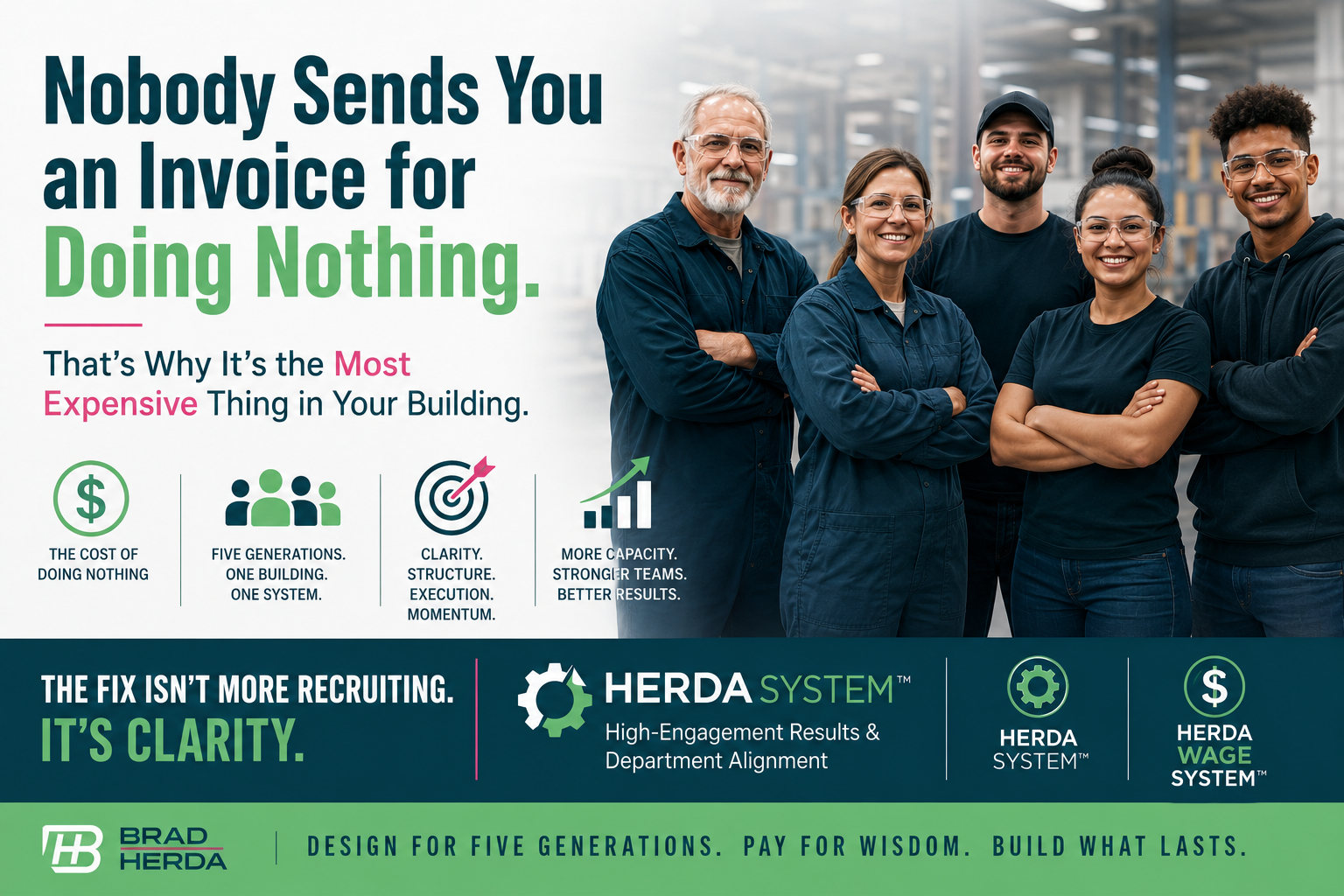
You define it, score it, and put a wage on it. The HERDA System writes the bridge work into what winning looks like in the role, and the Herda Wage System turns teaching and error prevention into a number Bill can see and move.
Here’s the real reason Bill feels invisible. Most shops only measure what comes off the line. Parts out the door. Hours on the job. Bill’s best work is the stuff that didn’t happen. The scrap that never got made. The injury that never got reported. The new hire who didn’t quit in week two. You can’t recognize what you never wrote down.
Define what winning looks like. The HERDA System™ (High-Engagement Results & Department Alignment) is a results-first operating framework for manufacturing, construction, and skilled-trades companies with 35 to 200 direct-labor employees. It defines what winning looks like in every role by measurable results, not task lists. For Bill’s seat, the bridge work goes on the page: trainees signed off, two people qualified on every critical task, problems caught before they reach the customer. Now his invisible work has a scoreboard.
Put a wage on it. The Herda Wage System is a three-part pay formula (Production 50 percent, Tenure 25 percent, Wisdom 25 percent) that places each person inside a market wage band based on what actually makes him valuable. Wisdom is where Bill lives. Teaching and mentoring are scored on a ten-point scale, from Knowledge Hoarder at one to Legacy Builder at ten. Error prevention runs from Reactive Firefighter to System Protector. The things Bill does every Tuesday night finally show up on his check.
Make it the standard. When the guy who teaches out-earns the guy who hoards, everybody in the building learns the lesson. That’s how one Bill turns into three.
That’s the flip. Five generations on one floor isn’t a headache you survive. It’s a lineup. And every lineup that wins in October has a utility guy the manager trusts with the game on the line. Pay him like it.
Your challenge this week: the Bill Test
Write your Bill’s name across the top of a sheet of paper. Five points, one for each yes.
1. In the last 30 days, have you thanked him for something specific, a named moment and not “good job”?
2. Is the training, covering, and problem-catching he does written into what winning looks like in his role?
3. Does his pay reflect what he teaches and prevents, not just what he produces and how long he’s been here?
4. Have you asked him what’s slowing him down, and fixed at least one thing he named?
5. Does he know, in plain words, what his next step in your company looks like?
Add it up.
4–5: You’ve got a Bill who’s staying. Keep building, and keep saying it out loud.
2–3: He’s still here. He’s also keeping score. Start with question one this week.
0–1: Bill is either updating his résumé or pricing a used truck and a sign. Have the conversation before Friday.
The guy holding your business together doesn’t need a trophy. He needs to know you see him.
Habits equal results — decide accordingly.
So answer me this. Who’s the Bill in your building, and when did you last tell him exactly what he did right?
Quick Answers
Why do Gen X employees feel overlooked at work?
Per the Achievers Workforce Institute’s 2025 State of Recognition study, only 17 percent of Gen X feel regularly and meaningfully recognized, the lowest of any generation, and they report the lowest sense of belonging at 22 percent. Much of their work is prevention, which rarely gets noticed, and they’re less likely to speak up.
What percentage of the construction workforce is Gen X?
About a third. NAHB’s October 2025 analysis of Census data puts Gen X at 33.7 percent of the construction labor force in 2023, while Boomers fell to 14.2 percent and Gen Z rose to 14.1 percent.
How do you keep Gen X supervisors in a manufacturing or construction company?
Four moves: specific recognition tied to results, ownership instead of oversight, a visible next step such as a partner track or buy-in, and pay that rewards teaching and error prevention, not just output and years in the building.
What is the HERDA System?
A results-first operating framework from Brad Herda for manufacturing, construction, and skilled-trades companies with 35 to 200 direct-labor employees. HERDA stands for High-Engagement Results & Department Alignment. It defines what winning looks like in every role by measurable results, so supervisors manage to results instead of personalities.
What is the Herda Wage System?
A three-part pay formula (Production 50 percent, Tenure 25 percent, Wisdom 25 percent) that places each employee inside a market wage band. The Wisdom score rates things like teaching and mentoring, error prevention, process knowledge, versatility, and quality mindset, so the people who make everyone else better get paid for it.
Tag your Bill. Drop a comment with your Bill’s first name and one thing he does that never shows up on a report. Better yet, tag him. Fifteen seconds of public recognition, and you just passed question one.
Tell me your number. Run the Bill Test and reply with your score, 0 to 5. I read every one, and I’ll tell you straight where to start.
Then let’s dig into it. When your best lead hand has gone quiet, or you’re not sure the people holding your shop together will still be there in three years, that’s a design problem, and design problems are fixable. Thirty minutes, no charge, no slide deck. We walk your roster, find your Bills, and look at whether your roles and your pay reward the work that keeps you running. You leave with the first move whether we ever work together or not. Email bherda@focalpointcoaching.com or go to vfbsolutions.com to grab a time.
Bring Brad to your event. When your association, leadership group, or industry conference is wrestling with a four- and five-generation workforce, my signature talk “We Grew Up Different” hands your audience a practical, no-fluff framework they can use the very next morning. Real operational experience on the stage, not academic theory. bradherda.com.
When this topic is of interest to you, invite me to talk about it in greater detail.
About the author. Brad Herda is The Blue-Collar Business Guy, a business coach, keynote speaker, and consultant in Sussex, Wisconsin, who works with multigenerational, family-owned manufacturing, construction, and skilled-trades companies through Vision Forward Business Solutions and FocalPoint Coaching. He spent decades in subcontract manufacturing leadership, created the HERDA System™ and the Herda Wage System, co-hosts the Blue-Collar BS Podcast, and delivers the keynote “We Grew Up Different.”
Sources: Achievers Workforce Institute, 2025 State of Recognition, “Recognition Is the Great Equalizer to Unite the Five-Generation Workforce” (October 28, 2025) · Fortune, “Gen X is the most overlooked generation in the workplace” (October 7, 2024, citing Achievers and the Workforce Institute at UKG 2023) · NAHB Eye on Housing, “Median Age of Construction Labor Force Holds at 42” (October 2025) · Contractor Magazine, “Skilled Labor by the Numbers” (Harris Poll data) · The CPA Journal, “Succession Woes? Generation X May Be the Cure” (February 2017, citing EY and Sage) · Becker’s, “7 things to know about Gen X in the workplace” (December 20, 2024) · Deloitte and The Manufacturing Institute, U.S. manufacturing workforce outlook to 2033.
Brad Herda
Vision Forward Business Solutions
Supporting blue-collar businesses to win their game every day